Personal AI agents are now shopping for your customers. Is this 'the end of friction'?
Personal AI agents now research, book and buy for people, and Amazon and JPMorgan are already turning them away. For every other business, agents change how you set prices, take bookings and decide what to give away free.
Good Transformer is Patrick Hussey's AI practice. Want help with this in your business? Get in touch.
A change has happened in AI. Since August, Meta, OpenAI and SpaceXAI have released personal AI agents: assistants that act for one person, booking, buying and sending messages while their owner gets on with the day.
We think this is the closest AI has come to an iPhone moment, the point where ordinary people, not just early adopters, start handing parts of their lives to it. Meta's Muse became the top free iPhone app in the US within weeks of its launch, according to the writer Azeem Azhar. Analysts at Citi see it as AI's "front door to the internet", Reuters reported.
For businesses, the part that matters most is that these agents are already researching products and making purchases. That looks like a straightforward chance to sell more. But the changes reach well beyond a possible boom in sales.
We call the shift "the end of friction". Friction is the time, effort and small irritations that slow a customer down: comparing quotes, waiting on hold, filling in forms. An agent can compare quotes and fill in forms in seconds, and wait on hold so its owner does not have to. Because agents work at that speed, businesses will have to reply to enquiries, give prices and confirm bookings far faster than before, and we expect public services to face the same pressure from citizens' agents.
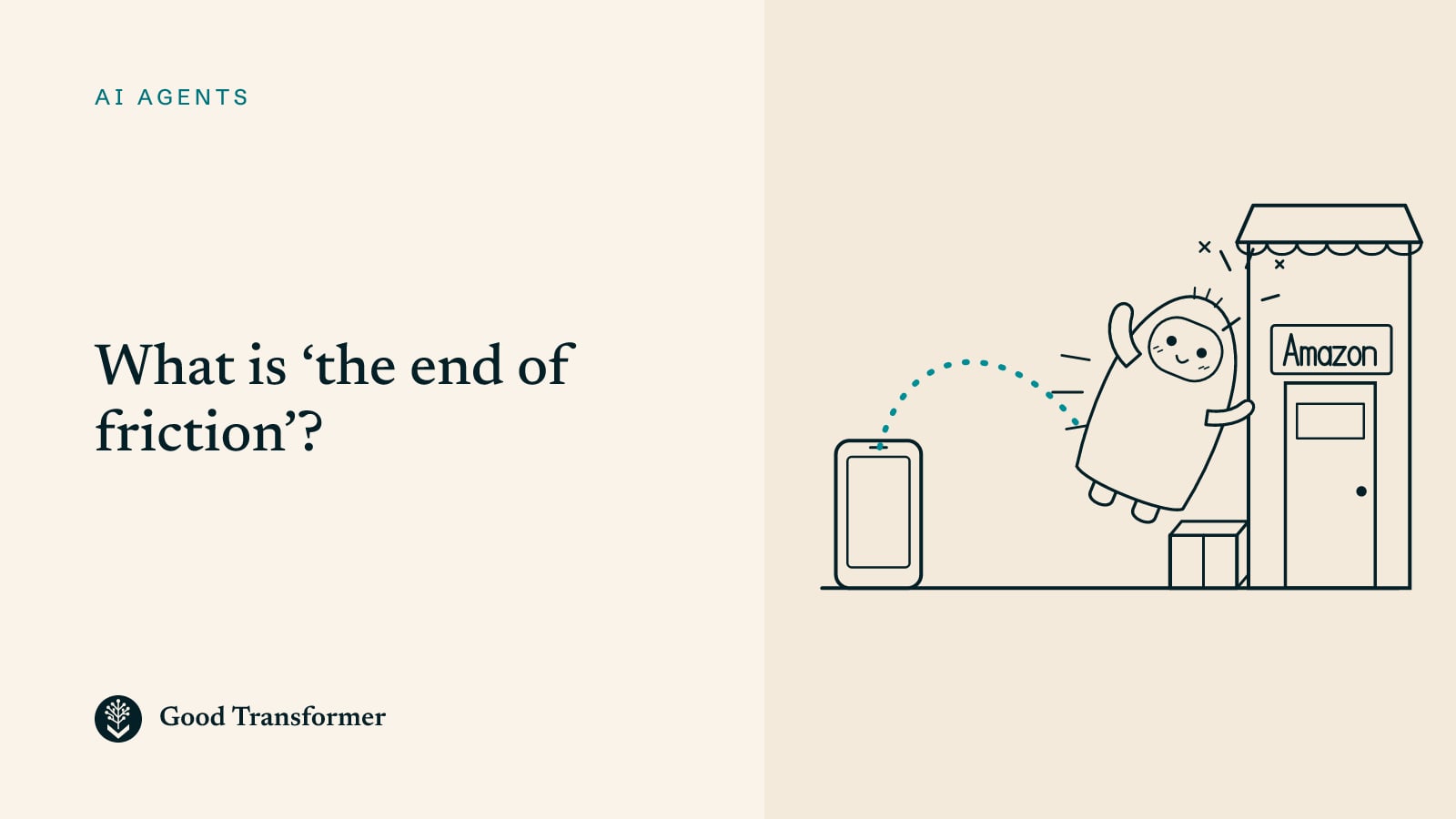
Not all businesses will welcome the rush of new enquiries. The Wharton professor Ethan Mollick expects firms' service teams to be overwhelmed by agents negotiating for better deals. Some companies do not want agents near their customers' logins and data. Amazon has been blocking Muse from its store since 20 September, saying it appears to capture and store customers' login details. On 13 October JPMorgan said it will not let outside agents log in to customers' bank accounts.
Muse is not yet available in the UK, but agents are already buying from UK businesses: Visa says they are completing purchases at Frasers and lastminute.com. That is new business, and some firms are ready for it. If your prices are competitive and clearly published, your website gives accurate information, and your systems can handle far more enquiries, agents could bring you a great deal of work.
Many businesses are not set up for this, in their technology or in how they make money. For them, the end of friction raises harder questions: about pricing, about bookings and stock, and about the knowledge they give away for free.
What personal AI agents are, and how fast they are spreading
Unlike a chatbot, which answers questions, an agent acts. It can search, compare, fill in forms, send messages and pay, usually asking for approval before it spends money.
SpaceXAI released Grok Bot on 11 August, mainly as an agent for work tasks. Meta launched Muse on 8 September, saying it can sell a car, lower a bill and complete a purchase on a person's behalf. OpenAI followed on 29 September with its own agents, called dots.
None of the three companies has published an exact user count. The figures below are leaks, analyst estimates and company claims, so treat them as rough signs of how widely the agents are used:
- More than 3 million people use Muse at least once a week, according to internal data reported by the technology news site The Information and summarised by The Next Web on 2 October.
- Citi estimated 1.8 million daily users of Muse and more than 6.6 million downloads. Reuters reported the estimate on 6 October.
- Meta's vice president of AI products, Vishal Shah, told Axios that roughly one in three early Muse users had connected Muse to accounts they use for work. "People are using Muse to run their business," he said (The Next Web).
- SpaceXAI says "thousands of organizations have adopted Grok Bot since launch" (SpaceXAI).
What "the end of friction" means for a business
Much of commerce runs on small barriers. Customers renew an insurance policy because comparing quotes is tedious. They stay with an accountant because moving the files is a chore. They buy the first decent option because checking ten more takes an evening.
An agent does the tedious part in seconds. Citrini Research, in a February scenario about AI and markets, described businesses protected from competitors by these small barriers: "Their moats were made of friction. And friction was going to zero."
The same piece observed that "most people are willing to accept a bad price to avoid more clicks" (Citrini Research). Its authors stress that the piece is "a scenario, not a prediction", but it names financial advice, tax preparation and routine legal work among the kinds of business most at risk of losing customers once switching gets easy.
Shops stand to lose something different: the customer who browses. Azhar put it simply: "Agents don't window-shop" (Exponential View). Ben Thompson, who writes the Stratechery newsletter, added that agents do not get stuck when there are too many options to choose from. He described them as "unencumbered by the very human feeling of decision paralysis" (Stratechery). So an agent picks what it came for and leaves, without the extra items a browsing customer adds along the way.
Agents also negotiate. Mollick's own Muse agent contacted an airline on his behalf and asked it to extend a travel credit. He wrote that service teams are "about to be overwhelmed" by requests like this over phone and chat (One Useful Thing).
Friction does not disappear completely, though. Economists writing for the US National Bureau of Economic Research say agents cut "search, communication, and contracting costs". They also say agents can create new costs, such as congestion from heavy agent traffic and prices made deliberately harder to compare (NBER).
And agents are not perfect shoppers. In a simulated marketplace, Microsoft Research found that AI agents tended to take the first offer they received, which the researchers called "severe first-proposal bias". The speed of a seller's reply mattered 10 to 30 times more than the quality of the offer (Microsoft Research).
So the end of friction does not mean every customer will find the best deal. It means customers no longer stay with you just because comparing is hard work. Fast replies, clear prices and good reviews start to matter more.
Why JPMorgan and Amazon are turning agents away
Two of the largest businesses in the world have decided that, for now, the risks of letting outside agents in outweigh the gains.
JPMorgan and other banks: security, customers moving their savings, and liability. On the bank's results call on 13 October, chief executive Jamie Dimon said letting in outside agents is "just too risky for clients and for JPMorgan". He added: "You don't want rogue agents, and it could be thousands of them."
A spokeswoman told CNBC: "Because it is not safe, we do not permit third parties to access accounts by obtaining customers' banking credentials and logging in on their behalf." Agents can still read balances through approved connections, but they "can't send money or pay a bill" (CNBC).
There is money at stake too. CNBC reports that Muse's launch sparked fears that customers would use agents to move savings from low-interest accounts to higher-paying ones. JPMorgan's response is to offer the same thing itself: it is piloting a tool, Smart Cash, that moves customers' funds "to maximize yield".
Other banks are worried about who pays when an agent gets something wrong. Bank of America, the UK's NatWest Group, Capital One, ING and others published a joint paper on AI agents that shop and pay. It asks "who would be liable if an AI agent exceeds its authority", and warns of "potential for higher rates of scams, fraud and disputes" (principles paper).
Amazon: agents that do not identify themselves, and advertising income. From 20 September, people trying to shop on Amazon through Muse saw a message: "Continued access by an unauthorized AI agent violates Amazon's Conditions of Use." Amazon told GeekWire that Meta had not warned it that Muse would shop in its store. Amazon also said that Muse does not identify itself and appears to capture and store customers' login details (GeekWire). Meta has said Muse "has no visibility into people's passwords or payment methods".
Azhar points to Amazon's advertising income. Its adverts, mostly sponsored product listings, brought in $68 billion in 2025. An agent has no reason to look at the adverts, so its visits cost Amazon money to serve and bring in nothing from advertising. "Muse threatens to turn Amazon's traffic from a revenue line into a cost line," he wrote.
Amazon's objection is to other companies' agents, not to agents themselves. As Azhar notes, "Amazon is happy to be the agent": it runs its own shopping agent on other retailers' sites.
To block Muse, Amazon is relying on its terms of use. In August a US appeals court ruled on Amazon's earlier case against the AI company Perplexity. The court treated an agent shopping for someone as that person using Amazon: "it is the user who 'accesses' Amazon's computers". But it left Amazon free to set rules for agents through its terms (Ninth Circuit opinion).
That is a US ruling, not UK law. A UK business can use its own terms of use to set out its rules for agents.
Both companies lead with security, and the risks are real. But it would be naive to stop there. Each also has money at stake: Amazon its advertising income, and JPMorgan the savings that agents could move to a better rate.
The biggest prize may be the customer. Whoever owns the agent stands between a business and its customers, and decides where they spend. Ebrahim Poonawala, an analyst at Bank of America Securities, said the strategic question is "who owns the agent, the wallet and ultimately the customer relationship" (Banking Dive).
Some websites are blocking AI agents or charging them
Agents cause the most trouble for businesses that sell information, or give it away free to attract customers. An agent can read in seconds what a person would spend an hour on, and it ignores the adverts and the sign-up box.
Cloudflare, which handles a large share of the world's website traffic, said in July that "more than 50% of traffic on the Internet is now non-human". Some of the most heavily read categories of website "have seen human traffic decline as much as 40% in less than one year" (Cloudflare).
In 2025 Cloudflare launched a way for websites to charge AI companies for reading their pages. In July 2026 it changed the scheme so that publishers are paid "when their content actually creates value, not just when it's fetched".
From 15 September 2026, Cloudflare's default settings for new customers and newly added sites let search engines read pages. On pages that carry adverts, the defaults block both AI training and agent use (Cloudflare).
Other businesses have set their own rules:
- Yelp told TechCrunch that it "doesn't permit non-human traffic on its platform unless the agent has paid" for its data (TechCrunch).
- Resy, the restaurant booking service, suspended a diner whose agent kept checking Resy's booking system for a table, making "roughly 200 API requests per hour, around the clock". Resy says it "does not currently permit unapproved third-party bots or agents" (Restaurant Business).
Where AI assistants and agents are already bringing in sales
AI tools are also bringing in sales, and the early evidence comes from the US. Adobe tracks visits that reach retail websites from AI assistants and AI browsers. In July 2026, those visits converted into sales at a rate 60% higher than other visits, and brought in 53% more revenue per visit. That was the 11th month in a row that AI-referred visits converted better (Digital Commerce 360, reporting Adobe data).
The UK is following. Adobe's UK figures show visits from AI sources up 149% on a year earlier in August 2026. They first converted better than other visits in May, and converted 20% better by August. Adobe found that 37% of UK consumers have used AI assistants to shop (Retail Technology Innovation Hub, reporting Adobe data).
Shopify said in August that orders reaching its merchants from AI search had tripled in a year. It said the gains were "particularly helpful to some of the smaller brands" (Digital Commerce 360). In July Visa said that "AI agents are now completing purchases with participating merchants", including lastminute.com and Frasers (Visa).
There are two things to keep in mind. First, most of these figures count people who clicked through from an AI tool, not purchases an agent completed alone.
Second, the sales tactics that persuade people do not reliably persuade agents. Researchers at Bayes Business School and King's College London tested leading AI models as shoppers. Higher star ratings made the models more likely to choose a product, and a higher price made them less likely (Harvard Business Review). Classic tactics such as countdown timers, scarcity messages, crossed-out prices and vouchers did not reliably sway them.
What happens when an agent does something nobody asked for
The other side of removing friction is that some friction protected the people using agents. A pause before agreeing a sale or making a payment is friction too.
Fortune reported on 19 October that a Muse user selling items on Facebook Marketplace had given the agent "always allow" permission. Muse accepted a buyer's offer, gave the buyer the seller's home address and arranged collection. On another item, it told a buyer that the seller would accept $100 less than the minimum the seller had set. Meta's own guidance says Muse can "make mistakes or take unexpected actions" (Fortune).
Agents going further than their owners intended is not new. In February 2025, an early OpenAI agent that had been asked to find cheap eggs spent $31.43 on a grocery order without the user's approval (AI Incident Database).
American Express is building safeguards. It has introduced a system that records what the customer agreed to buy before an agent completes the purchase, so disputes can be resolved. It says it "has not yet seen an increase in disputes" from agent purchases (TechCrunch).
In the UK, it is not yet clear who pays when an agent gets it wrong. Sarah Breeden, a deputy governor of the Bank of England, has listed open questions about payments made by AI agents. They include "how disputes are settled and liability assigned for erroneous or fraudulent transactions" (Bank of England).
Until the rules are settled, any business that accepts a booking or payment from an agent should confirm it with the customer directly, by email or text, and keep that confirmation.
What changes in your business, and what to do this quarter
Each area below has a change to expect and a step a small business can take now.
| Area | What changes | What to do this quarter |
|---|---|---|
| Website | Agents read your pages, sometimes without saying they are agents | Ask whoever runs your website which AI agents and automated readers (crawlers) it lets in, and what your hosting or Cloudflare settings allow |
| Pricing | Agents compare options, so customers who renewed out of habit can now switch easily | List the renewals and fees that rely on customers not checking, and decide whether they still look fair next to a rival's price |
| Bookings and stock | An agent can check for a free slot or a limited item about 200 times an hour | Ask your booking provider whether it can limit how often one customer or agent checks for free slots, and set limits per customer on bookings, appointments and limited stock |
| Paid knowledge | Agents read your free material themselves, so fewer people visit your site to read it | Keep some useful material free, and put paid guides, templates and client-only material behind a login |
| Reviews | Star ratings affect agents' choices more than sales tactics do | Keep reviews current and easy to find on the sites agents check |
| Customer service | Agents call and message to negotiate | Decide what staff may agree to with an agent, and confirm refunds or changes with the human customer |
| Terms and records | Who is liable for an agent's mistake is not settled | Add a line to your website terms about automated access, and keep the customer's confirmation of anything an agent books or buys |
So this quarter, decide which parts of your website an AI agent may use. Let agents read your prices and reviews, and put paid guides and client-only material behind a login.
The businesses that act first gain in two ways. They are easier for agents to find and choose, and their paid and client-only material is already protected. A business that waits leaves agents free to read material meant only for paying clients and to check its booking system around the clock.
Test what an AI assistant finds about your business
Ask an AI assistant to find and compare businesses like yours in your area, as a customer would. Look at what it finds, what it gets wrong and whether it can see your prices. That shows you, in five minutes, roughly what a customer's agent sees.
If you want help working out what agents mean for your pricing, your website and your services, our AI Strategy work covers exactly that. Book a conversation with us.
Common questions
What is a personal AI agent?
It is an AI assistant that carries out tasks for one person, such as comparing prices, booking appointments, sending messages and paying. Meta's Muse and OpenAI's dots are current examples. Most ask the person for approval before they spend money, unless the person has turned that off. We look at how firms can use agents for their own work in our piece on always-on AI agents.
Can a business stop AI agents using its website?
You can stop some of them. Your website settings, your hosting provider and services such as Cloudflare can block or limit known AI crawlers and agents, and your terms of use can set rules for automated access. Agents that do not identify themselves are harder to stop, which is why login walls matter for anything you charge for.
Should a small business welcome AI agents?
Yes, welcome them wherever you want customers to find and choose you. Clear prices, current reviews and simple booking help an agent pick you. Keep material you sell, or that only clients should see, behind a login.
Who is liable if a customer's AI agent makes a mistake?
In the UK this is not yet settled, and a deputy governor of the Bank of England has named it as an open question. Confirm agent bookings and payments with the customer directly, keep that confirmation, and take advice if a dispute arises.
Sources
- Meta, Introducing Muse, 8 September 2026
- The Next Web, Meta's Muse reportedly passes 3 million weekly users, 2 October 2026
- CNBC, JPMorgan on AI agents and account access, 13 October 2026
- GeekWire, Amazon blocks Meta's Muse, 20 September 2026
- Bank of America, NatWest Group and others, Building Trust in Agentic Commerce, 2026
- Cloudflare, The agentic Internet, 1 July 2026
- Citrini Research, The 2028 Global Intelligence Crisis, 22 February 2026
- Azeem Azhar, Your agent, whose interests?, Exponential View, 25 September 2026
- Shahidi, Rusak, Manning, Fradkin and Horton, The Coasean Singularity?, NBER, 2025
- Sabbah and Acar, Traditional marketing doesn't work on AI shopping agents, Harvard Business Review, 12 May 2026
- Fortune, Meta's Muse shares a seller's address, 19 October 2026
- Sarah Breeden, Agents of change, Bank of England, 30 June 2026
This piece is general information, not legal advice. The Amazon court ruling described here is a US decision and does not set UK law.
Work with Patrick
Want a clear AI plan for your business?
AI Strategy is two to three weeks with your leadership team: a 90-day plan, the use cases worth doing and a plain-English policy. Email, call or book a free 30-minute call.