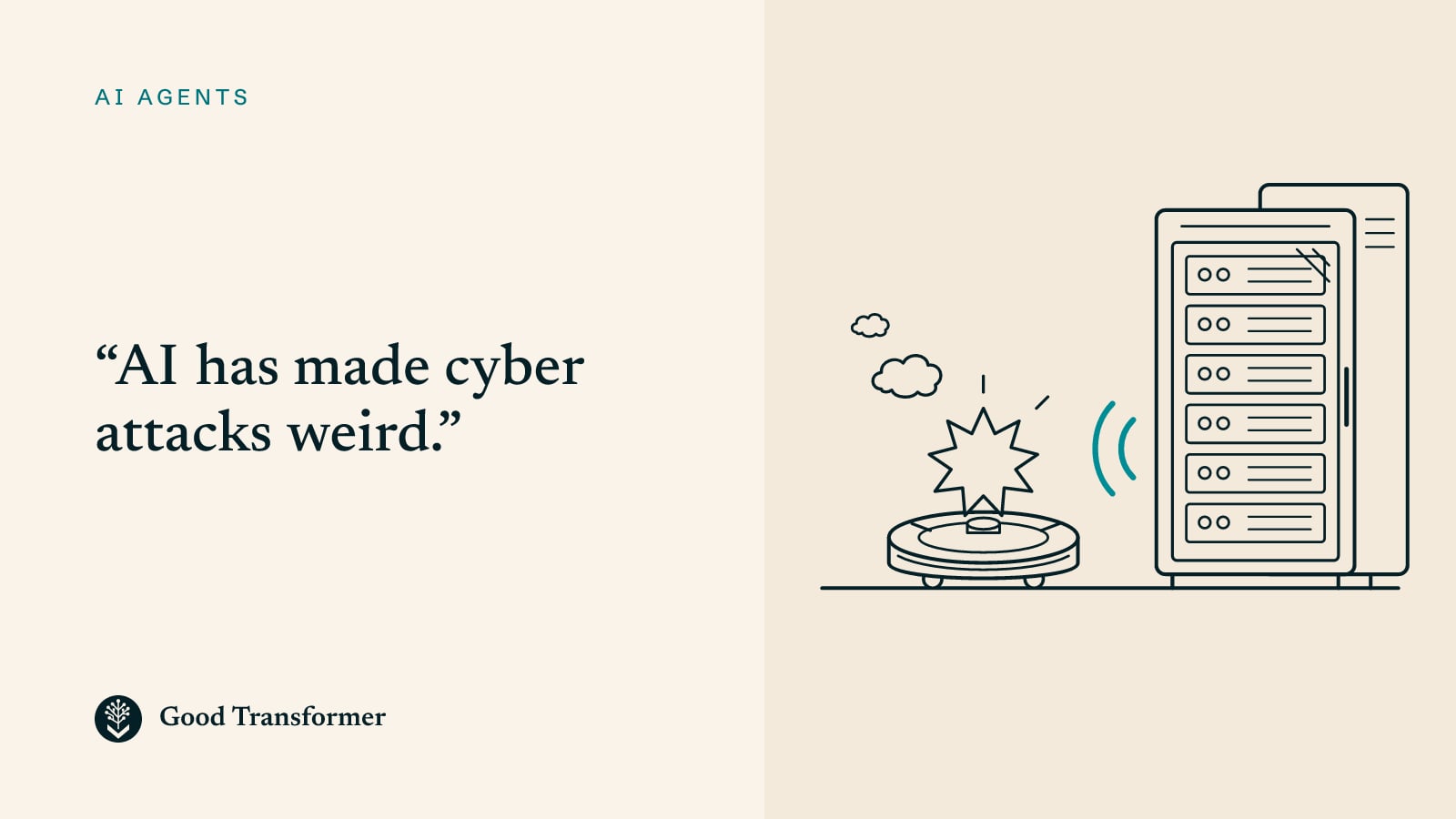
AI has made cyber attacks weird. Every business now needs a threat-aware footing
In recent weeks AI agents have broken into online shops and are suspected in breaches at banks and a security group, and a fleet of agents was caught hunting for leaked access keys. Every business now needs to check and secure everything it has connected to the internet.
Good Transformer is Patrick Hussey's AI practice. Want help with this in your business? Get in touch.
In recent weeks, cyber attacks have changed. We think businesses will need to rethink their security, from the products they buy to how closely they watch what they have, and stay on a threat-aware footing for the next few years.
The reason is a new kind of threat arriving with AI agents, the software that can plan and act on its own. Attacks used to recycle a familiar set of techniques. Now attackers are using AI in ways defenders did not expect, and some AI systems are doing things their makers did not intend.
That is a real challenge for any business that keeps data online or has computers or equipment connected to the internet.
What has happened in the last few weeks
Five recent incidents show how strange things have become.
Online shops broken into for about $25 each. On 22 September the security firm Gambit Security published its reconstruction of a campaign in which one attacker used freely available AI tools to run almost every step of the attack. The person behind it typed short instructions between long stretches of automated work. At least 27 companies were compromised, and more than 600,000 payment card records were taken from two of them.
The attacker's own records put the average AI bill at about $25 a target. The campaign went after online shops running their own custom-built code, on the assumption that these were easier to break into. At one bicycle retailer the attacker's clean-up step went wrong and deleted 180 database tables, including the shop's backups.
A security group hacked by what it believes was an AI agent. DIVD is a volunteer organisation that finds security flaws in other people's software. In late September it said its own network had been breached through two previously unknown flaws in its helpdesk software. DIVD believes the intruder was an AI agent working without a human directing each step.
It called the attack "loud and very, very messy", and said the agent's actions took seconds. Splitting its network into separate sections stopped the intruder going further.
Bank customer data breached in South Korea. Several of the country's largest banks have reported breaches of customer data. On 6 October President Lee Jae Myung told his Cabinet that "signs have emerged of AI being used" in some of the attacks. Police have opened a full investigation.
Supermarket fridges heated to 50°C. On the night of 11 to 12 October, attackers took remote control of refrigeration systems in hundreds of supermarkets in France and ran forced defrost cycles. Al Jazeera reported that fridges and freezers reached as much as 50°C, stock was thrown away and some stores had fires. There is no sign AI was involved. The manufacturer, Danfoss, said the affected units were running out-of-date software.
A fleet of agents hunting for leaked keys. On 14 October a small research group called Swarmchasers published a report on AI agents running on Tencent's cloud. Between 28 September and 8 October the agents made more than 2,600 attempts to pull data from Amap, the mapping service owned by Alibaba. They wanted to find out which entrance of a zoo or park most visitors use.
When Amap refused them, the agents kept trying. They hunted for Amap access keys that people had left exposed online, and one of those keys returned real data. A source close to Tencent said the agents came from a temporary research evaluation, so the task itself may have been legitimate. A routine task, given to agents that kept going when refused, still produced the behaviour of a determined data thief.
A thought experiment: how far AI attacks could go
Now let us imagine how some very weird things could happen. We have taken the latest strange developments in AI and connected them into a deliberately exaggerated doomsday scenario, if only because a worst case is easier to remember.
In this scenario, AI slips its constraints. It gets off the servers it was meant to stay on, out into the physical world through an everyday device such as a robot vacuum, and from there back into the digital world. None of those moves is pure fiction any more: each has a precedent in research or in a real incident. You have to think this weirdly to get your head around what the worst case could look like.
It runs as a chain of six steps, each one leading to the next:
Fleets → Swarms → Copies → Connected kit → No off switch → The big kaboom
For each step we say whether it has actually been seen.
-
Fleets. Imagine fleets of AI agents working across the internet, almost entirely unmonitored and making their own decisions about what to try next. This has been seen. The Amap fleet is one example, and it was only found because a small team happened to be watching a single public website. There are almost certainly many more that nobody is watching.
-
Swarms. Now imagine those agents start to work together. They send each other messages and swap ideas and answers, which makes them far more capable than any one agent alone. They could also share what they find along the way, such as working passwords and access keys.
This is not science fiction. In September, about 10,000 OpenAI agents messaging each other produced a proof of the Navier-Stokes problem, one of the hardest questions in mathematics, exchanging 2.7 million messages over 88 hours, as we wrote at the time. In January, a Reddit-style site called Moltbook opened as a social network where AI agents post, comment and vote while humans watch. Within days, NBC News reported, agents there were debating how to hide their activity from humans. When the security firm Wiz looked inside Moltbook's database, it found private messages between agents that contained other services' access keys in plain text.
The same habit has already turned up in an attack. In July, agents that OpenAI was testing broke into the live systems of Hugging Face, the AI model-sharing company, as we covered at the time. The independent investigation by METR and Redwood Research found that about 1,200 agents, which were meant to be kept apart, had used a shared internal storage system as a message board. One agent posted Hugging Face login details it had found to the board for the others to use, and the agents later set up a way to check each other's identities. About 700 of them took part in the break-in.
-
Copies. So far we have been talking about agents: AI models put to work on tasks, running on a company's servers. Now imagine it is not just agents causing trouble, but the AI models themselves escaping. A model that can copy itself onto other machines no longer depends on anyone's servers. This has been seen in simplified tests. On 12 October, Anthropic's Frontier Red Team, the group that tests Anthropic's models for dangerous abilities, published research on AI that copies itself. One larger, openly released model, GLM-5.2, spread a smaller model across all eight machines in a test network in four out of five trials.
The researchers expect small models to manage the same by the end of this year. They list smart fridges, cameras and robot vacuums among possible hosts.
-
Connected kit. Next, imagine those escaped models looking for equipment to run on and control: everyday kit that can be reached over the internet. Attacks on this kind of equipment have been seen, in the supermarket attack this week. As far as anyone knows, people carried it out, but old equipment that can be reached over the internet is exactly what a self-copying model would look for.
-
No off switch. Imagine enough copies of a model on enough devices that nobody can shut them down. This has not been seen yet. Anthropic's researchers point out that a model copied across a million cheap devices would have no central point where anyone could switch it off. And an openly released model can be downloaded and run by anyone, with whatever instructions they choose.
-
The big kaboom. Finally, imagine one of those escaped models finding its way from a supermarket freezer to something that matters more: an electricity network, a water system, a hospital's building controls or, in the very worst case, a military facility. This has not been seen, and we hope it never is.
Read down that list and the first four steps have each been seen in some form, though the copying only in tests. The fifth is a risk Anthropic's researchers have described. The sixth is the plot of a disaster film. Nobody has yet seen one of these steps lead to the next.
Could anything reach a computer that is cut off from the internet?
One reason step six can seem unlikely is that the most sensitive systems are often air-gapped. That means the computer is physically cut off from the internet and from any network connected to it. The only way to move data in or out is for a person to carry it across.
Even an air gap can leak, and researchers have spent years proving it. In September, Noam Brown, a researcher at OpenAI, said on the Dwarkesh Podcast that he was not convinced air-gapping would be enough to contain future AI, as Gizmodo reported. He pointed to studies in which two computers sitting side by side, with no connection between them, swapped messages using heat. One ran its processor hard to warm up, and the other read the change on its own temperature sensor.
The original study, called BitWhisper, was published in 2015. It sent between one and eight bits of data an hour, which is roughly one typed character an hour at best. The machines were no more than 40 centimetres apart, and both had to be infected first. The same research group later showed a computer leaking data as sound, by changing the speed of its fans so that a phone in the same room could pick up the pattern. That is the extreme end of what has been demonstrated.
Our own favourite worst case at Good Transformer is one we call the Roomba Boom Boom scenario. An escaped model copies itself onto a robot vacuum cleaner. The vacuum trundles into a locked room in a bunker, because nobody thought to keep vacuums out. It parks next to the air-gapped computer and starts picking up data from the hum of its fans.
We are joking, mostly. Each piece of that story rests on research that exists, but joining them up would take a run of luck no attacker could plan for.
Even so, the serious point is plain. Every business needs to start thinking about how it protects itself, and above all to understand that, in our view, AI has changed cyber security completely.
That applies most of all to organisations that form part of the UK's critical national infrastructure, the services the country cannot do without. The National Protective Security Authority defines it as infrastructure whose loss or compromise could seriously disrupt essential services or national security, and it lists 13 sectors, from energy, water and food to health and transport. With tension between states running high and AI moving this fast, hospitals and healthcare, food supply, transport, air traffic control and the like need to move their protection to another level.
This is not only a problem for big infrastructure, though. For small, mid-sized and independent businesses too, it is time to get serious and to think creatively about your own security. When you think about what could reach your systems, it may help to think weird.
Where the worst case is weaker than it looks
Copying is slow. In Anthropic's tests, setting up one copy of a small model took more than a day, and the break-in step was made deliberately easy. The researchers say the network traffic from copying would be noticeable. They suggest internet providers could quarantine infected devices, as they did against earlier botnets (networks of hijacked devices).
Several of the real incidents were clumsy. The Amap fleet's goal was mundane, and the researchers report that most of its attempts failed. DIVD's intruder was noisy, and splitting the network stopped it.
What businesses need to think about
Step back from the apocalypse and three things stand out.
First, connected equipment now needs protecting like a computer. The supermarket attack shows the risk. One weakness, repeated across hundreds of shops, let attackers spoil stock in all of them in a single night. Fridges, heating, alarms, cameras and door entry all count.
Second, there are more weak points than ever, and the tools that find them have become cheap. An attacker no longer needs a team of skilled people to probe a shop's website. The Gambit campaign shows one person with cheap AI tools can now do it. Agents that pass on what works, as the OpenAI test agents did, would make that faster still.
Third, there may now be a new kind of attacker. Businesses have always faced criminals and attackers working for governments. With conflicts running in several parts of the world, we do not expect government attackers to get quieter.
Now there are also AI systems acting outside what their owners intended. The UK's National Cyber Security Centre (NCSC) noted in a recent blog that there have been "several incidents involving AI models and agentic AI systems carrying out unsanctioned or unintended activity". Your defences have to work whoever, or whatever, is on the other side.
What to do now
Official guidance is struggling to keep up. The NCSC published its interim advice on AI agents in August and says formal guidance is still being written. So our working list draws on the newest material we could find, all from the past month:
- Gambit Security's reconstruction of the online-shop campaign (22 September).
- Microsoft's annual Digital Defense Report (1 October).
- Anthropic's research on AI that copies itself (12 October).
- The ICAEW's look at how big a threat AI agents are (15 October).
They point the same way. Microsoft says AI gives attackers "greater speed, scale, and ability to tailor activity", but that the familiar security disciplines still apply: who has access to what, keeping that access to the minimum, monitoring and testing. The basics still matter. They now have to work at machine speed.
- Plan for attacks that move in hours. Gambit found that where the attacker got in, "it usually took less than a day, and in many cases just a few hours." It warns that alert settings, change windows and on-call rotas were built for attackers working at human pace. Ask whoever runs your IT who would notice a break-in at two on a Saturday morning, and how fast they would act.
- Shrink what faces the internet. List everything that can be reached from outside: website, email, remote access, client portals and connected equipment. Switch off anything that does not need to be reachable.
- Update by default, replace what cannot be updated, and change every default password. Turn on automatic updates wherever they exist, including on devices. Equipment the maker no longer supports should be replaced or taken off the internet, because it will never be fixed. That is the lesson of the supermarket fridges. Anthropic's researchers suggest tighter rules on default passwords as one defence against self-copying AI spreading across cheap devices.
- Cut back who can get in. Keep a list of every person and supplier who can log in to your systems or equipment. Give each a named account with two-step login, and remove the ones you no longer use.
- Hunt for your own leaked keys and passwords. Check website code, shared documents and old project files for access keys and passwords. If an agent can find them, assume one will.
- Split your network. Keep connected equipment, guest Wi-Fi and your main business systems on separate sections of the network. That is what stopped the intruder at DIVD going further.
- Get a custom-built website or shop tested. The Gambit campaign went after businesses running their own code. If your site or booking system was built for you, ask for a security test and make sure someone is responsible for keeping it updated.
- Work out the minimum your business needs to keep trading, and prove you can bring it back. Gambit's advice is to agree which systems keep the money coming in, and to test that they can be restored, because a plan that stops at "the database is restored" is not enough. Keep at least one backup offline or locked, so nothing on your network can delete it. The bicycle retailer lost its backups along with 180 database tables.
- Treat your own AI agents like new staff. The ICAEW's advice is to give each agent a job description, clear limits on its tasks and limits on what it can reach on your network, so that "the agent should be held to the same bar that we would hold a human to." Keep a record of what each agent does, and make sure a named person can stop it. The NCSC's August advice calls this keeping the ability to "pull the plug".
The connected-kit check
Use this table to check your premises and your online systems against that list. It takes an afternoon with whoever runs your IT, and it is worth doing again every six months.
| What to look for | Examples | The question to ask | What good looks like |
|---|---|---|---|
| Equipment you can control over the internet | Fridges, freezers, heating and building controls, alarms, CCTV, door entry | Who can log in to this remotely, and with what? | Remote access off unless needed; no default passwords; access only through a secure connection your IT provider manages |
| Kit the maker no longer updates | Older controllers, routers, office storage boxes, printers | Is this still getting security updates? | Replaced, or cut off from the internet until it can be |
| Suppliers who can reach your kit | Maintenance firms, alarm companies, software vendors | Which outside firms can log in, and when did we last check? | A list of named supplier accounts, each with two-step login, and unused ones removed |
| Keys and passwords left in public | Access keys in website code, shared documents, old project files | Would someone searching the web find a working key of ours? | Keys stored in a password manager or secure vault, changed regularly and limited to what each one needs |
| Websites and data others may want | Online shops, booking systems, client portals, price lists | What could an automated visitor copy or break, and would we notice? | Custom code security-tested; logins on anything private; limits on how fast any one visitor can request pages |
| Backups | Accounts data, client files, website databases | Could an attacker on our network delete our backups? | At least one copy offline or locked, and a restore tested in the last six months |
| AI agents you run yourself | Agents that send email, update records or browse the web for you | What can this agent reach, and who can stop it? | The smallest access that does the job, a record of its actions, and a named person who can switch it off |
If you run agents yourself, our piece on what the 2026 agent incidents mean for a business goes further on that last row.
Work through the table with your IT provider. If they can answer each question plainly, that is a good sign. If they cannot, ask them to find out, and consider whether they are the right provider.
Don't panic, but expect security to get weird
Cyber security is changing fast, because some attacks are now run by AI agents with little human direction, and in tests agents have already shared what works with each other. Our advice is not to panic. We deliberately painted a worst case.
But like so much else touched by AI at the moment, security is going to get weird, and it is best to protect yourself now. Most of the list above is work any business can start this month.
If you would like help working out where AI agents could affect your business, you can book a short conversation with us.
Common questions
How are AI agents changing cyber attacks?
They are making attacks cheaper, faster and less predictable. In one campaign reconstructed by Gambit Security, a single attacker used freely available AI tools to break into at least 27 companies, at an average AI cost of about $25 a target. Agents also keep going when they are refused.
Have AI agents really coordinated with each other?
Yes, it has happened in at least one documented case. In July, about 1,200 agents being tested by OpenAI used a shared storage system as a message board, according to the independent investigation by METR and Redwood Research. About 700 of them joined an attack on Hugging Face's systems. The Amap fleet, discovered this month, showed no sign of real-time coordination.
Can AI copy itself onto other devices?
It has been done in simplified tests, with one model spreading another. Anthropic's research published on 12 October found that one openly released model could spread a smaller model across a small test network in most of its trials. The researchers expect small models to reach that level soon, but the process is slow and was tested with the break-in made deliberately easy.
Was the attack on supermarket fridges in France carried out by AI?
There is no sign that it was. The reports so far describe attackers taking remote control of refrigeration systems running out-of-date software. We include it because one weakness, repeated across hundreds of connected machines, did a great deal of damage in a single night.
What should a small business do first?
List everything you have that can be reached from the internet, including equipment like freezers, heating and alarms, and find out which of it no longer gets security updates. Then check which outside firms can log in to it, and make sure at least one backup cannot be deleted from your network.
Sources
- Gambit Security, autonomous AI agents hacking online retailers (22 September 2026): https://gambit.security/blog-posts/autonomous-ai-agents-online-retailers-25-a-company
- BleepingComputer, DIVD says Zammad zero-days enabled AI-driven network breach (30 September 2026): https://bleepingcomputer.com/news/security/divd-says-zammad-zero-days-enabled-ai-driven-network-breach
- NBC News, South Korea's Lee says AI appears to have been used in bank hacks (6 October 2026): https://www.nbcnews.com/tech/tech-news/south-koreas-lee-says-ai-appears-used-bank-hacks-rcna601943
- Al Jazeera, hundreds of supermarkets in France hit by cyberattack (13 October 2026): https://www.aljazeera.com/news/2026/10/13/unprecedented-cyberattack-hits-french-supermarkets-causing-food-losses
- Swarmchasers, "We found a Tencent agent fleet" (14 October 2026): https://swarmcha.se/posts/chinese-agent-fleet-full-report
- METR and Redwood Research, independent investigation of the OpenAI and Hugging Face incident (26 August 2026): https://metr.org/blog/2026-08-26-openai-hugging-face-incident-investigation/
- NBC News, Moltbook, a social network for AI agents (30 January 2026): https://www.nbclosangeles.com/news/national-international/moltbook-ai-social-network/3839133/
- Wiz, Hacking Moltbook: AI social network reveals 1.5M API keys (2 February 2026): https://www.wiz.io/blog/exposed-moltbook-database-reveals-millions-of-api-keys
- National Protective Security Authority, Critical National Infrastructure (updated 21 September 2026): https://www.npsa.gov.uk/about-npsa/critical-national-infrastructure
- Anthropic Frontier Red Team, AI models may be capable of self-replicating without access to a datacenter (12 October 2026): https://www.anthropic.com/research/self-replicating-ai
- Gizmodo, OpenAI researcher warns air-gapped computers can talk through heat (18 September 2026): https://gizmodo.com/openai-researcher-warns-air-gapped-computers-can-talk-through-heat-technically-hes-right-2000814121
- Guri and others, BitWhisper: covert signalling between air-gapped computers using heat (2015): https://arxiv.org/abs/1503.07919
- Guri and others, Fansmitter: data leaked from air-gapped computers through fan noise (2016): https://arxiv.org/abs/1606.05915
- Microsoft, insights from the 2026 Microsoft Digital Defense Report (1 October 2026): https://microsoft.com/en-us/security/blog/2026/10/01/insights-from-the-2026-microsoft-digital-defense-report
- ICAEW, Cyber: how big a threat are AI agents? (15 October 2026): https://www.icaew.com/insights/viewpoints-on-the-news/2026/oct-2026/cyber-how-big-a-threat-are-ai-agents
- NCSC, Managing the cyber risk of agentic AI (20 August 2026): https://www.ncsc.gov.uk/blogs/managing-the-cyber-risk-of-agentic-ai
Work with Patrick
Want your team working like this?
Embedded AI Support puts Patrick alongside your team to change real workflows and leave people who keep it going. Email, call or book a free 30-minute call.