Kimi K3 cuts the price of AI work. Here is how to judge it.
Moonshot AI's new model costs a fraction of the closed leaders and can be downloaded from 27 July. The benchmark scores are the weakest reason to care. Here is what changes for your firm and how to test it.
Good Transformer is Patrick Hussey's AI practice. Want help with this in your business? Get in touch.
What is all the fuss about Kimi K3, the new Chinese AI model? It comes down to one word. Price. Automated work that costs about $500 a day on the most expensive AI model costs about $150 on this one, and that gap affects your firm even if you never touch the model itself.
Kimi K3 comes from Moonshot AI, a Beijing lab little known outside the AI world. Big new models arrive most months, and most of them change nothing for a small firm. Two things set this one apart.
The first is how good it is. Artificial Analysis, an independent evaluator, ranks it fourth of 186 models, just behind the flagship systems from Anthropic and OpenAI.
The second is that on 27 July Moonshot will publish the weights, the files the model is made of, so anyone can download it and run it on their own machines. The leading American models are rented through their makers and cannot be owned. Nathan Lambert of the Allen Institute for AI calls this the closest open models have been to the frontier since DeepSeek R1 at the start of 2025.
For your firm that matters in three ways: pressure on the price of every AI product you already buy, a cheaper engine for any AI work you run directly, and a realistic way to keep sensitive work on machines you control. The launch benchmark scores are the weakest evidence in the story.
What Moonshot has shipped
Moonshot released Kimi K3 through its own service on 16 July, with the weights following on the 27th.
It is built as 896 specialist sub-models, of which only 16 do the work on any given word. That design is why a very large model can run at a modest price. It handles roughly 750,000 words of input at once, accepts images, and always uses its slower step-by-step mode, which raises answer quality and token consumption together.
Moonshot's published pricing is $3.00 per million input tokens and $15.00 per million output tokens. Tokens are the units these services bill in, at roughly four tokens for every three words.
Two caveats come before the numbers. Nobody outside Moonshot has yet run the model on their own hardware, so every claim rests on the company's own service. And nobody yet knows the licence terms: they arrive with the weights on the 27th. The previous model, K2.6, came under a modified MIT licence, but that does not bind K3.
The price, which is the solid part
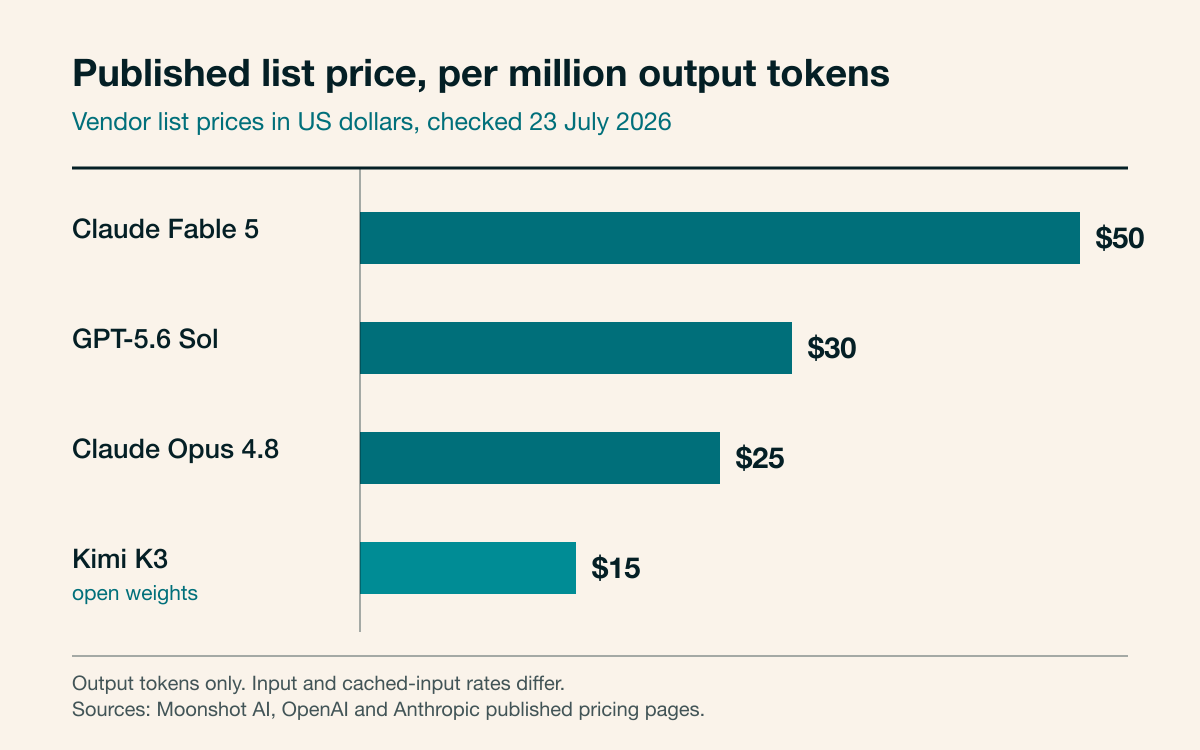
Those are list prices for output, checked against each vendor's own pricing page on 23 July. Kimi K3 sits at $15 per million against $50 for Claude Fable 5 and $30 for GPT-5.6 Sol. That is under a third of Fable 5 and half of Sol. All three vendors publish in US dollars.
The catch is that a cheaper model can still cost you more per job. Artificial Analysis calls K3 "notably slow and very verbose". It used 130 million output tokens getting through their evaluation, against an average of 63 million for comparable models. A model priced at a third of its rival but writing twice as much is not a third of the cost.
Why the benchmark scores are the weakest part
There are two specific reasons to distrust the launch numbers, and neither is that the lab is Chinese.
The first is that they are self-reported, which is what separates them from the independent ranking above. The vendor chooses which tests to run, how hard to run them, and which rivals to show. The writer Zvi Mowshowitz put the point sharply: "All its benchmarks are scored at maximum effort, typically a lot more tokens than are used in similar tests by Fable or Sol." A model allowed to think for longer scores better than one held to a tighter budget, and the published scores do not say what budget each model got.
The second is that the leaderboards those numbers feed are distorted, industry-wide. The most rigorous study of that distortion, "The Leaderboard Illusion", found the biggest advantages sitting with the largest American labs. Meta tested 27 private versions of its model before the Llama 4 launch and published the best one. Leaderboard position is weak evidence about any model, wherever it was built.
One disinterested measurement exists, with real limits on it. On 17 July the UK's AI Security Institute published an estimate of how far downloadable models trail closed ones, using security tasks only. It put the lag at four to seven months, against the six to ten months it had measured through 2025.
The institute says explicitly that this covers security work and that you cannot read across to other abilities. It had not tested Kimi K3, and says it intends to once the weights are out.
Moonshot's own announcement concedes that K3's performance "still trails the most powerful proprietary models, Claude Fable 5 and GPT 5.6 Sol". Developers who tested it early, whose accounts Mowshowitz collects in his roundup, found it uneven, as very new models usually are. They report it strong on multi-step coding and front-end work, weaker on unfamiliar code, on prose, and on security tasks.
The sensible response is Ethan Mollick's. He recommends you give a model a job interview, built from your own realistic tasks and graded blind by your own experts.
What this changes for your firm
Most readers will never install an AI model, and do not need to. What to do depends on how you buy.
If your AI arrives inside software you subscribe to, this is a signal about your renewal, not a job for you. The cost of the intelligence inside those products is falling fast. Ask your suppliers which model sits behind the features you use, and what happens to your price when they switch to a cheaper one.
If anyone in your firm calls an AI service directly, through a bespoke tool or an automation, this is a live decision about cost. The trial at the end of this piece is for you.
If you handle work that cannot leave a jurisdiction or your own network, a downloadable model of this quality moves self-hosting from theoretical to practical. That is a conversation to have with whoever runs your infrastructure.
Which work to send to a cheaper model
The choice is made task by task rather than once for the whole firm.
| Type of work | Where to send it | Why |
|---|---|---|
| High-volume sorting, tagging, data extraction | Cheaper model | Unit cost dominates and the task is easy to mark |
| First-pass review that a person checks after | Cheaper model | Mistakes get caught downstream, volume is high |
| Work that cannot leave your network or country | Downloadable model, self-hosted | You control where it runs |
| Long multi-step runs over your own code | Cheaper model, after you test it | This is K3's strongest reported area |
| Novel analysis and final client-facing writing | The expensive model | Low volume, and the quality difference shows |
| Occasional, low-volume use (under about 750,000 words a month) | Whichever performs best | At that volume the price difference is a rounding error |
Firms that do this well send some task types one way and keep the rest where they are. Andy Fang, chief technology officer at DoorDash, described doing exactly that in early July.
His team built an internal coding benchmark first. Only then did they add a cheaper model to their automated code reviewer, keeping the expensive one for the hardest work. He reported better quality at lower cost, though he published no figures.
The order is the part worth copying. They measured first and changed the routing second.
One further case justifies a downloadable model even when the sums are marginal. A copy you hold cannot be withdrawn or repriced by its vendor, and its behaviour will not change unless you change it. We think most firms still underrate that risk in their vendor continuity planning.
The limits are real too. Running a model this size yourself needs a serious cluster of machines. Most firms will use a hosted provider instead, which gives them the lower price without the control. Without engineering capacity you will get the same result from a good subscription, and our view that buying beats building for most small firms still holds.
The two-week model trial
Before you move any real work to a new model, run this. It takes a fortnight, and the team that does the work can run it.
- Pick six real tasks. Take them from work your team did last month, with the actual inputs and the finished output. Cover your range: one high-volume routine job, two typical jobs, two hard ones, and one you expect the model to get wrong.
- Write down what good looks like for each, before you see any output. A sentence or two will do.
- Run each task three times through each model, wording the request the same way every time, because the same request does not produce the same answer twice.
- Have the person who owns that work mark the outputs blind, without knowing which model produced which.
- Note how long each answer is. If your interface shows no token count, answer length is a fair stand-in. A model that writes twice as much costs roughly twice as much.
| # | Task (from real work) | Model A /5 | Model B /5 | Length A | Length B | Would you send this to a client? |
|---|---|---|---|---|---|---|
| 1 | High-volume routine job | Y / N | ||||
| 2 | Typical job | Y / N | ||||
| 3 | Typical job | Y / N | ||||
| 4 | Hard job | Y / N | ||||
| 5 | Hard job | Y / N | ||||
| 6 | Expected failure | Y / N |
Move a task type to the cheaper model only if it scores within one point of the expensive one on all three runs. Run the sheet twice a year, and whenever a supplier tells you the model behind one of your tools has changed.
What to do this month
If you buy your AI inside software, add one question to your next supplier review: which model is behind this, and what happens to our price when it changes. If anyone calls these services directly, put K3 through the sheet above once the weights land on 27 July. If your data cannot leave a jurisdiction, start the self-hosting conversation now.
The one thing not to do is choose on a leaderboard. The published scores describe a fixed set of tests, and those tests are not the work you do.
If you want help deciding which of your processes should move to a cheaper model, book a conversation with us.
Work with Patrick
Want a clear AI plan for your business?
AI Strategy is two to three weeks with your leadership team: a 90-day plan, the use cases worth doing and a plain-English policy. Email, call or book a free 30-minute call.